

By this coming August, 80 years will have gone by since the raid on Dieppe, and Canadians will still be arguing about it. It remains a matter of contention in some of the regiments that were there, especially The Royal Regiment of Canada, still based at Fort York Armoury. There remain people with strong views about the raid, sometimes because of the uncle they never knew or the brother who never came back.
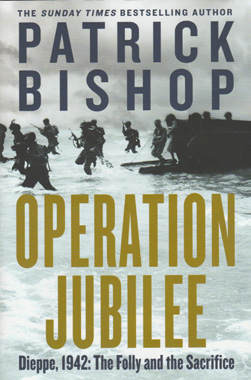
The fires of contention have never gone out, and another log has just been tossed into the flames. It’s from a British author, Patrick Bishop, who has long been a journalist with a strong interest in military history; he was with the Queen’s forces in the Falkland Islands and has written a book (along with several on the RAF) on 3 Para’s early battles in Afghanistan. His latest is titled Operation Jubilee: Dieppe 1942: The Folly and the Sacrifice.
Most of the dead, wounded and captured were Canadian
The sacrifice at Dieppe was immense and unequivocal. All the involved units took heavy casualties, the Royals most of all: 556 of them were aimed at a narrow beach just east of the town and 464 were killed or captured. Overall, of 6,050 men sent ashore, 3,623 became casualties. Most of the dead, wounded and captured were Canadian.
There isn’t much to show on the credit side of the ledger. Lord Louis Mountbatten and Winston Churchill both claimed there were valuable lessons learned from the disaster, but 60% casualties in one day is a very expensive way to learn.
The debate ever after has been on many levels: whether there were indeed lessons that were learned; and that the planning was shoddy, and so any lessons learned were that much more expensive; and that the raid was ill-conceived, unnecessary and unlikely to succeed, especially since it had already been cancelled once. Canadian nationalism, often fueled by drinks in the Legion, has held that Canadians were deliberately sacrificed.


Patrick Bishop’s log on this fire is incendiary. He has gone through the primary source material, particularly the surviving planning files and operational logs. The book is well buttressed with detailed new maps and 40 well chosen photographs (and although the index is excellent, there’s no bibliography, only notes).
Countering his arguments is not an exercise for the faint-hearted. However…
Debates over beers about Op Jubilee frequently come down to a dislike of Earl Mountbatten (then the Chief of Combined Operations) and Bernard Montgomery, who was involved in the preparation for Dieppe but was already off to the Eighth Army when the raid finally happened. Bishop levels his aim at both in his introduction – especially Mountbatten – and firmly establishes his own view. Mountbatten is charismatic, popular, and totally in over his head so far as combined operations go. Fair enough: it’s good to know what an author has decided.
Some of the myths of Dieppe are easily dispensed by Bishop
But there’s some context missing from Bishop’s book. While a private or a second lieutenant can be adequately trained in months, training competent staff officers takes much longer, and training skilled generals takes even longer. Personally, this reviewer takes a dim view of any judgement of generals that comes without any clear indication of having read Norman Dixon’s classic 1975 book On the Psychology of Military Incompetence. Moreover, combined-arms raiding and amphibious landings on defended beaches were new undertakings in 1942. The manuals were still being written.
In the First World War, competent planning took a long time to be achieved. The Canadian Corps successes at Vimy, Hill 70 and Passchendaele were a result of meticulous staff work – led and encouraged by Julian Byng and then Arthur Currie. The success of Amiens in 1918 saw Allied staff planning (after four years of fighting) achieve an incredible standard of efficiency.
Generally, that level of planning wasn’t achieved at Dieppe – but it was later. Dieppe’s small-stone beach presented unappreciated complications. From November 1942 onwards, reconnaissance by swimmers became a part of every Allied landing. The obstacles to getting off the beach at Dieppe were less imposing in 1944, at Normandy, when bunker-buster munitions, flamethrowers and the training to use them were so much more common – and not just in the hands of a few Commandos. Specialized armour was also invaluable on the British and Canadian beaches.
To his credit, Mountbatten had helped plan the Lofoten Islands raids in December 1941 and March 1942, the Bruneval Raid in February 1942, and the Saint-Nazaire Raid of late March 1942 – where 63% of 612 raiders were killed, wounded or captured in return for the destruction of the crucial Normandie dry dock. Each was risky and could have easily turned into a debacle. Dieppe did.
Some of the myths of Dieppe are easily dispensed by Bishop. The idea that the British were eager to use a Canadian division on a risky large raid goes square against the accounts of lobbying by Harry Crerar of Mountbatten and company for active employment for his Canadian troops. And the idea that Churchill wanted a blood sacrifice to show Stalin that his ‘Second Front’ arguments were premature is also discarded, and quite effectively.
The theory that the Dieppe Raid was a ploy to get a German Enigma machine is also dismissed by Bishop – it would have been a nice prize, but the Germans would have certainly noticed if the raid had succeeded in one set missing (and there were simpler schemes for a “pinch” that didn’t involve 6,000 troops and 250 vessels).
Speed and surprise are the keys to making combined-arms and amphibious landings work. The Germans failed utterly and at great cost in their April 1940 attempt to seize Oslo in the invasion of Norway, and the landings at Narvik cost the Kriegsmarine 10 of its destroyers. The town of Narvik itself was almost completely undefended.
The US Marines who landed on Guadalcanal on August 7, 1942, came ashore to almost no opposition and there were no towns – fortified or otherwise – to capture. More than a year later at Tarawa, where the Japanese did fight on the beaches, success was narrowly achieved for very heavy casualties.
The Allied landings in North Africa in November 1942 were against the dispirited Vichy French, yet the attempt to seize the harbour of Oran by a direct assault failed badly: 199 of the 405 American soldiers were killed, and all the rest were wounded or captured, while the two Royal Navy vessels in the assault were destroyed. This was the first time after Dieppe that Allied planners had attempted to directly assault an intact port, and it was the last time this was tried during the Second World War. The North Koreans attempted to seize Pusan at the opening moves of the Korean War in 1950 and lost their entire force.
Another factor to remember is the air battle that raged over Dieppe during the raid. The FW-190s of the Luftwaffe carried the day, scoring something like 100 kills of Allied aircraft versus 48 Luftwaffe losses. It is worth noting that no Allied invasion (except in the toe of Italy in September 1943) occurred after Dieppe without securing air superiority, if not total dominance ahead of time.
Bishop’s book on Dieppe is a well researched, well written and detailed account of the raid. A skilled writer and experienced journalist, he is a master of his craft. However, he has not been a staff officer and is not partial toward that breed. Operation Jubilee is well worth reading while memories of the Dieppe landings are still alive.
Original printed pages


