On July 30 last summer a statue of Joshua Glover was unveiled in a new park by the same name just off Dundas Street West, not far from the Humber River. I was particularly proud that day since the idea had been my initiative, based on a concept I’d had five years earlier. It felt great to think that I made it happen, but it was not without a lot of effort, patience and help from a number of people.
The idea for the statue came when I was visiting my mother in Penetanguishene. In 2015 the town had commemorated the arrival of Samuel de Champlain in the area by erecting a series of bronze statues honouring various people in the history of the town. There are statues of Champlain meeting Chief Aenon of the Wendat, of Étienne Brûlé, a group of First Nations women, Catholic priests, Simcoe and even the legendary giant Kitchikewana.
I am a lifelong lover of Canadian history with a degree in the subject, so the monuments thrilled me enormously. I began to think of my home of Etobicoke and wondered why it had zero historical monuments, in contrast to this small town.
This led me to join the Etobicoke Historical Society and initiate a program called “History and Art in the Parks” – a plan to get monuments into six different parks in Etobicoke. Not long after this, I approached Councillor Justin DiCianno and he was very supportive. He happened to have $50,000 in Section 37 money that hadn’t been earmarked and asked me whose statue I most favoured. I said Joshua Glover’s.
I had learned about Joshua Glover from the book Finding Freedom (by Walter McDonald and Ruby West Jackson) and was truly captivated by his story. Glover escaped from his slave owner in Missouri in 1852 but was recaptured shortly afterward in Wisconsin. He was jailed in Milwaukee but, fortunately for him, there were many abolitionists living there. Protesting outside his jail, they eventually broke into it and freed him. They helped him find refuge along the Underground Railway, which is how he came to Canada. Glover ended up working for Thomas Montgomery, who owned Montgomery’s Inn on Dundas Street. Montgomery also found him a place to live further east along Dundas, not far from where his statue is today.
What caught my attention about Glover was the way he was helped by the abolitionists, and the fact that sometime after he arrived, he married a white Irish woman named Ann. After she passed away, he married another woman of the same heritage. I think as Canadians we should be proud of the fact that he was accepted here as a free man and able to marry as he did.
The road to getting his statue erected was not smooth – I think it would have been simpler if I were in a small town like Penetang, as compared to working with the bureaucracy of the big city. I had to deal with the Arts & Culture Services section (the Public Art office) of Economic Development & Culture, which at first was a painfully slow process but in the end offered an enormous silver lining. The office forgot about me and routinely neglected to update me on any progress. I became so frustrated that I filed a complaint.
I also had to negotiate with the Toronto and Region Conservation Authority. After six months of inaction I inquired and it turned out that they had lost the file. My advice to anyone who wants to erect a statue in Toronto is don’t try to do it near a river, because the TRCA has too many hoops to jump through. This is a shame because we have many beautiful parks along our rivers and, with their own histories and attracting throngs of people, these parks are great places for statues.
After about three years of persevering and pestering, I was getting closer to the goal when the perfect spot for the Glover statue appeared. The City had just made a new park named after him on Brin Drive next to the new Kingsway by the River development of town houses and condominiums. There was one problem, however – it was located outside the ward where the Section 37 funds had been obtained. I thought I was facing another year of wrangling when miraculously the City division came through with a $50,000 budget for the project.
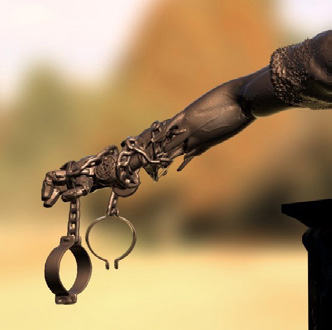
I was blown away by the design
At this point I took a back seat and the City did everything, including running a competition for the artwork and arranging for its production, along with the plinth and a plaque. Despite all my initial frustration with them, they did a wonderful job.
I never found out why they became so motivated, but I believe it was due to a couple of factors. First, after the death of George Floyd in 2020 there was an upsurge in the Black Lives Matter movement and a general awareness that Black people were underrepresented in many areas, including history. Though it’s hard to believe, there were no statues recognizing Black people in all of Toronto. The second factor is that 2021 was the year of public art, and the City wanted to make this statue a key piece of the celebration.
Our society member Neil Park was on the selection committee for the statue’s design (the others were David Chinyama, an artist; Julie Crooks, curator of African art at the AGO; Gaëtane Verna, director of the Power Plant; and Tim Whiten, artist and Professor Emeritus at York University). In July of 2020 Neil called to warn me that the committee’s unanimous choice was “quite different.” He wasn’t sure I’d like it.
Original printed pages